Keeping You Moving. Beyond Expectations.
We respond fast across Western Washington to treat icy lots, walks, and entrances when a freeze turns your surfaces into a slip hazard.
Emergency deicing in Kent is for the nights when ice forms and you need it treated now. Washington Snow Removal sends a crew from our Bothell yard to spread salt or ice melt on lots, walkways and entrances. We are licensed, bonded and insured.
Kent sees about 30 freezing nights between October and April. Snow is rare, but ice does not need much snow to cause trouble. Call 206-809-9669 to request a dispatch. Pricing is listed on this page, and each dispatch carries a 2-hour minimum.
Sources: NOAA and National Weather Service records for Kent, 2005–2026.
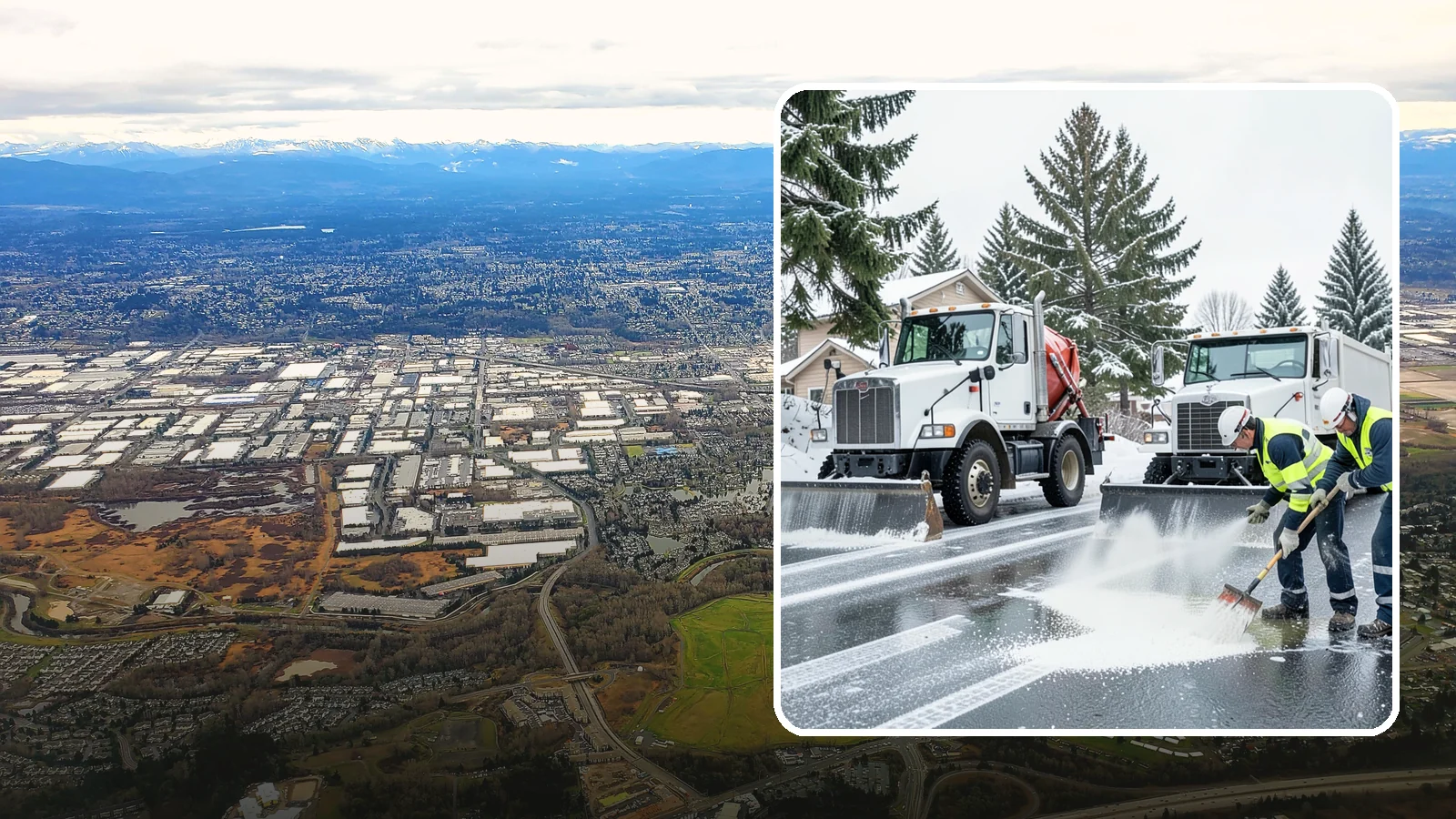
Emergency deicing is a short, targeted job. We arrive, apply salt or ice melt to the surfaces that matter, and clear slush or hand-work areas as needed. At Kent properties that usually means driveways, parking rows, loading areas, stairs and sidewalks.
Kent averages only 5.0 in of snow per season and about 1.3 days a year with 1 in or more. That means many properties have no regular winter service in place. When a storm does arrive, it can be large. The biggest single day since 2005 was 8.9 in, and the largest storm since 2005 reached 12.2 in. The area also averages 3.29 Winter Weather Advisories a year, and spotters reported 8 in near Kent on Feb 6, 2017.
Kent is 50 minutes from our Bothell yard, so dispatch is billed with a trip charge. Current rates:
All dispatches have a 2-hour minimum.
Billed by the hour for the crew and equipment on site, plus materials.
| Plow truck with driver (Ram 3500) | $250 / hour |
| Plow and spreader truck with driver (Ram 5500) | $325 / hour |
| Compact track loader with operator (Kubota SCL1000) | $175 / hour |
| Crew member (shoveling, sidewalks, hand work) | $110 / person-hour |
| Ice melt, bagged | $45 / 50 lb bag |
| Bulk salt, applied | $300 / ton |
| Trip charge for Kent (zone B) | $275 / dispatch |
Prices approved Oct 2026.
Rapid response to sudden ice and freeze events; Deicer matched to temperature and surface type; Targets the highest-traffic slip hazards first; Reduces injury risk and liability from icy surfaces