Keeping You Moving. Beyond Expectations.

Tacoma Anti-Icing
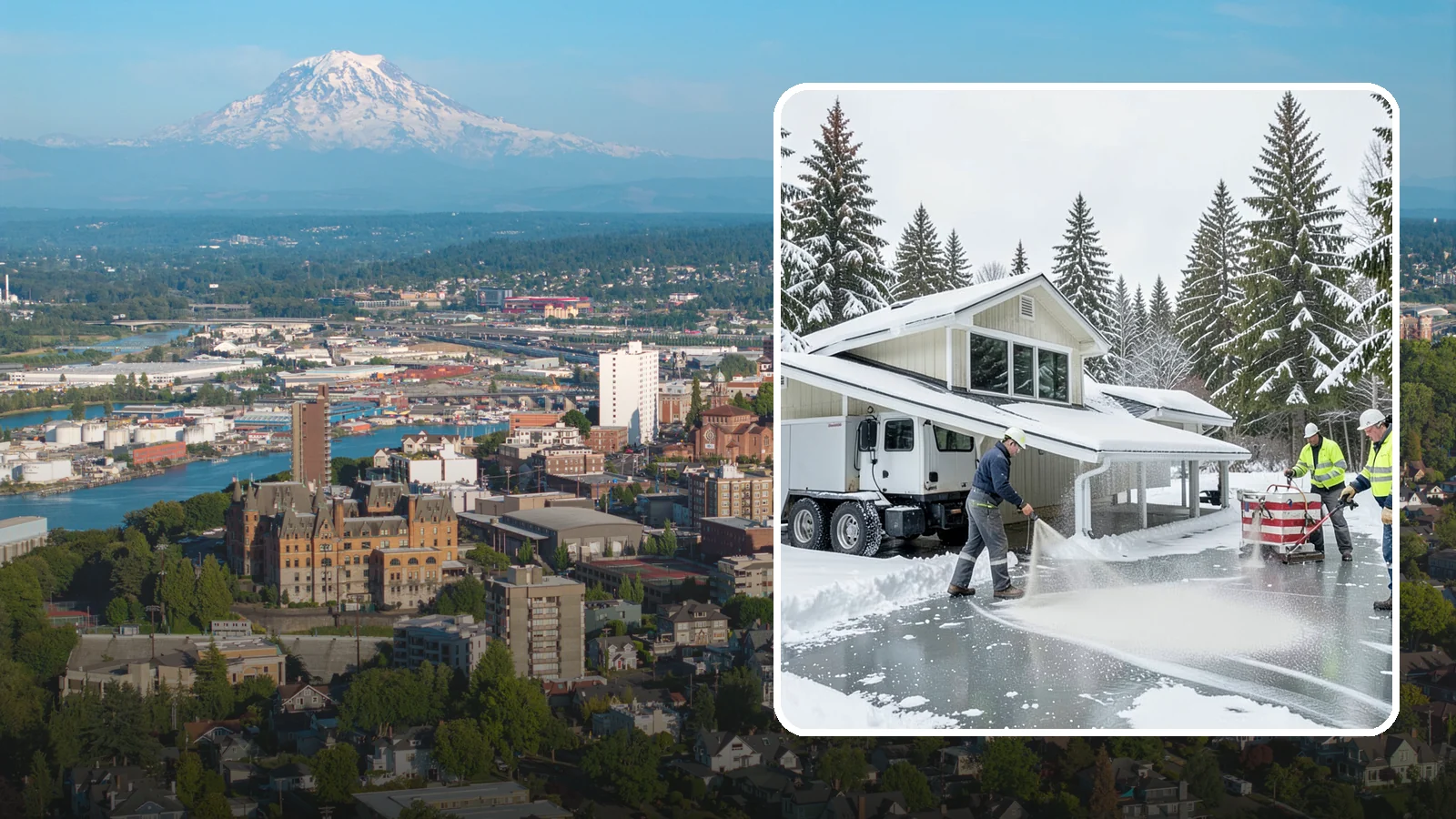
Anti-icing applies deicer proactively before a storm so ice bonds are prevented rather than broken after the fact.
Anti-icing means putting down a treatment before ice forms, so frost and freezing rain have a harder time bonding to pavement. In Tacoma, that matters on cold, clear nights more than on snow days. The city logs 31 freezing nights between October and April.
Washington Snow Removal is licensed, bonded and insured. We serve Tacoma from our Bothell yard, 73 minutes away. Call 206-809-9669 to talk through your lot, walks or entry points.
Ice and freezing nights in Tacoma
Ice storms and freezing rain near Tacoma
- Dec 23, 2022: Ice Storm; Freezing Rain reported at 1 N University Place
- Jan 19, 2012: Ice Storm; Freezing Rain reported at 4 W Federal Way
Sources: NOAA and National Weather Service records for Tacoma, 2005–2026.
How Anti-Icing Works Around Tacoma's Freezing Nights
Tacoma gets little snow. The average is 5.6 in per season, and only 1.6 days a year bring 1 in or more. Snow is on the ground about 3 days a year. The bigger risk is thin ice on a surface that looked fine at dusk.
Ice storms are rare but real. Two ice storm reports have been logged since 2005, including Dec 23, 2022 and Jan 19, 2012. Freezing rain was also reported at 4 W Federal Way on Jan 19, 2012. The area sees about 3.38 Winter Weather Advisories a year, so there are usually a few warnings to plan around.
An anti-icing visit usually involves:
- Walking the site to find walks, ramps, stairs and drive lanes that need treatment
- Applying bulk salt ahead of a forecast freeze
- Using bagged ice melt on small entries and tight spots
Tacoma code (TMC 9.16.050) makes the person in charge of a property responsible for clearing snow or ice from the public walks beside or in front of it. The deadline is 24 hours. Treating walks early makes that easier to meet.
Pricing: bulk salt, applied, is $300 / ton. Bagged ice melt is $45 / 50 lb bag. A plow and spreader truck with driver (Ram 5500) is $325 / hour. Tacoma is zone C, with a $350 / dispatch trip charge and a 2-hour minimum per dispatch.
Prices in Tacoma
Billed by the hour for the crew and equipment on site, plus materials.
| Plow and spreader truck with driver (Ram 5500) | $325 / hour |
| Bulk salt, applied | $300 / ton |
| Ice melt, bagged | $45 / 50 lb bag |
| Trip charge for Tacoma (zone C) | $350 / dispatch |
- 2-hour minimum per dispatch.
- Tacoma is 73 minutes from our Bothell yard.
Prices approved Oct 2026.
Service Area
Tacoma
Benefits
Prevents ice bonds before freezing rain arrives; Cuts the labor and material needed to clear surfaces; Targets freezing rain and drizzle unique to the PNW; Keeps access routes open from the storm’s first hour