Keeping You Moving. Beyond Expectations.

Bellevue Industrial Facility Parking Lot Snow Removal
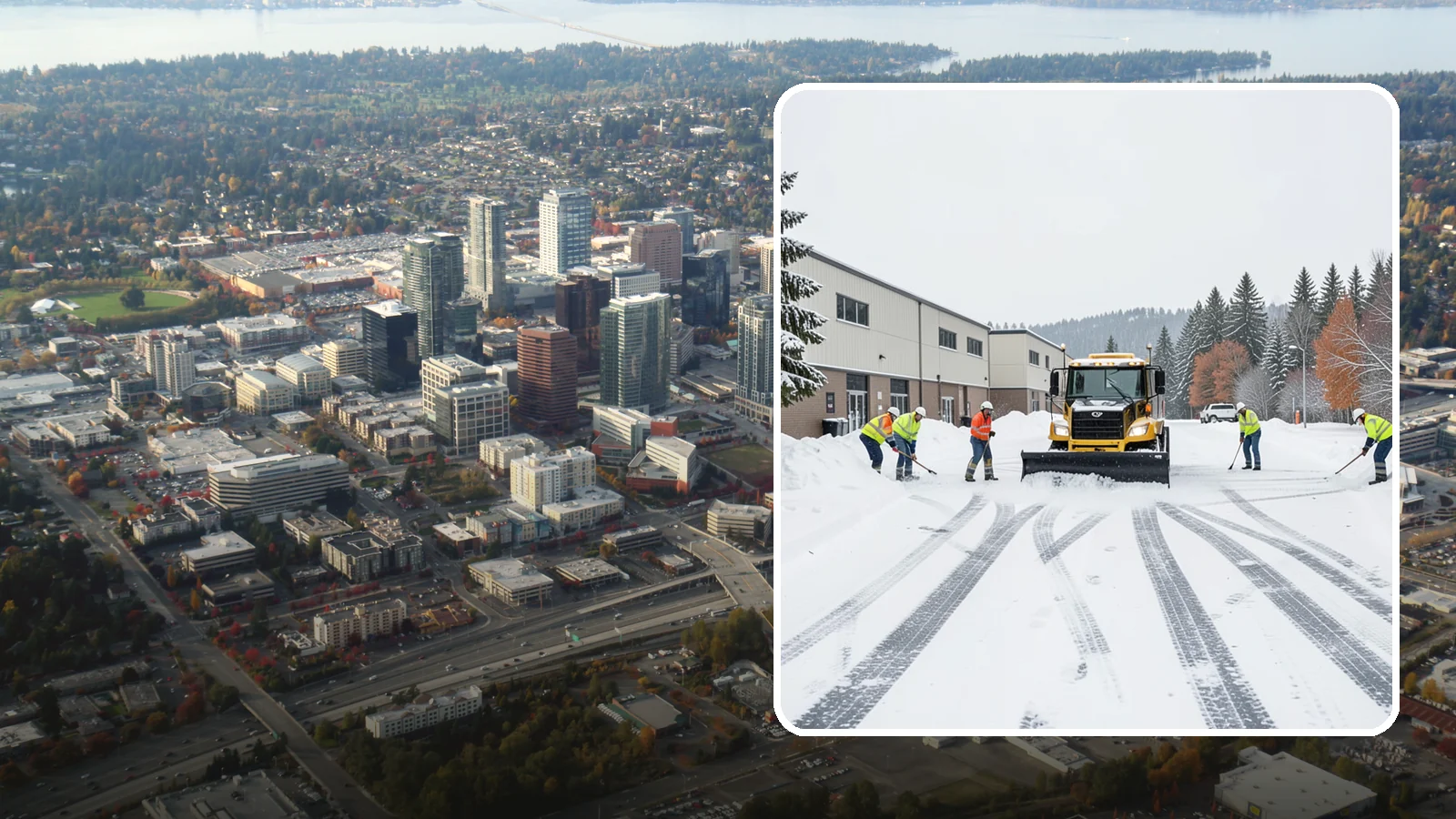
We clear large industrial lots and truck approaches so Western Washington operations keep running through winter weather.
Industrial lots in Bellevue need to stay open for trucks, deliveries and shift workers. Washington Snow Removal plows and treats industrial facility parking lots from our Bothell yard, 31 minutes away. We are licensed, bonded and insured.
Bellevue averages 7.2 in of snow per season and about 2.14 plow events. OpenStreetMap lists 21 industrial sites inside city limits, including 124th Plaza, Bellevue Parks Fleet, Cadman Inc and Coca-Cola Bottling. Call 206-809-9669 to talk through your lot.
What a Bellevue winter means for your lot
Recent winter storm and ice events logged for the Bellevue area
- Feb 4, 2025: Winter Weather
- Dec 23, 2022: Ice Storm
- Nov 29–Dec 1, 2022: Winter Weather; Heavy Snow
- Feb 8–11, 2019: Heavy Snow
Sources: NOAA and National Weather Service records for Bellevue, 2005–2026.
What Bellevue industrial lot snow removal involves
Industrial lots are large and busy. They have truck lanes, loading docks, employee parking and gate entrances. Plowing has to clear all of these without blocking bays or piling snow where trucks turn.
Bellevue gets few snow days. The city sees 2.1 days a year with 1 in or more of snow and about 1.05 Winter Storm Warnings. But it logs 30 freezing nights from Oct to Apr. That means ice is a bigger routine problem than deep snow. Recent events include Heavy Snow on Nov 29, 2022 and Dec 1, 2022 Winter Weather, plus Winter Weather on Feb 4, 2025.
Typical work at an industrial site can include:
- Plowing with a Ram 3500 at $250 per hour or a Ram 5500 plow and spreader at $325 per hour
- Tight corners and dock areas with a Kubota SCL1000 compact track loader at $175 per hour
- Hand shoveling at walkways and doors, $110 per person-hour
- Bulk salt, applied, at $300 per ton, or bagged ice melt at $45 per 50 lb bag
Each dispatch has a 2-hour minimum. The Bellevue (zone A) trip charge is $200 per dispatch.
Prices in Bellevue
Billed by the hour for the crew and equipment on site, plus materials.
| Plow truck with driver (Ram 3500) | $250 / hour |
| Plow and spreader truck with driver (Ram 5500) | $325 / hour |
| Compact track loader with operator (Kubota SCL1000) | $175 / hour |
| Crew member (shoveling, sidewalks, hand work) | $110 / person-hour |
| Ice melt, bagged | $45 / 50 lb bag |
| Bulk salt, applied | $300 / ton |
| Trip charge for Bellevue (zone A) | $200 / dispatch |
- 2-hour minimum per dispatch.
- Bellevue is 31 minutes from our Bothell yard.
Prices approved Oct 2026.
Industrial sites in Bellevue
OpenStreetMap lists 21 industrial sites inside Bellevue city limits.
- 124th Plaza
- Bellevue Parks Fleet
- Cadman Inc
- Coca-Cola Bottling
Source: OpenStreetMap contributors, Oct 2026. Named sites are examples of local facilities, not customers.
Service Area
Bellevue
Benefits
Large lots and truck approaches stay open to protect production; semi turning areas and gate approaches are cleared for heavy vehicles; dock ramps are deiced so loaded trailers keep traction; passes are timed around shift changes for every crew; scalable equipment matches the acreage of an industrial site