Keeping You Moving. Beyond Expectations.

Bellevue Parking Lot Sanding
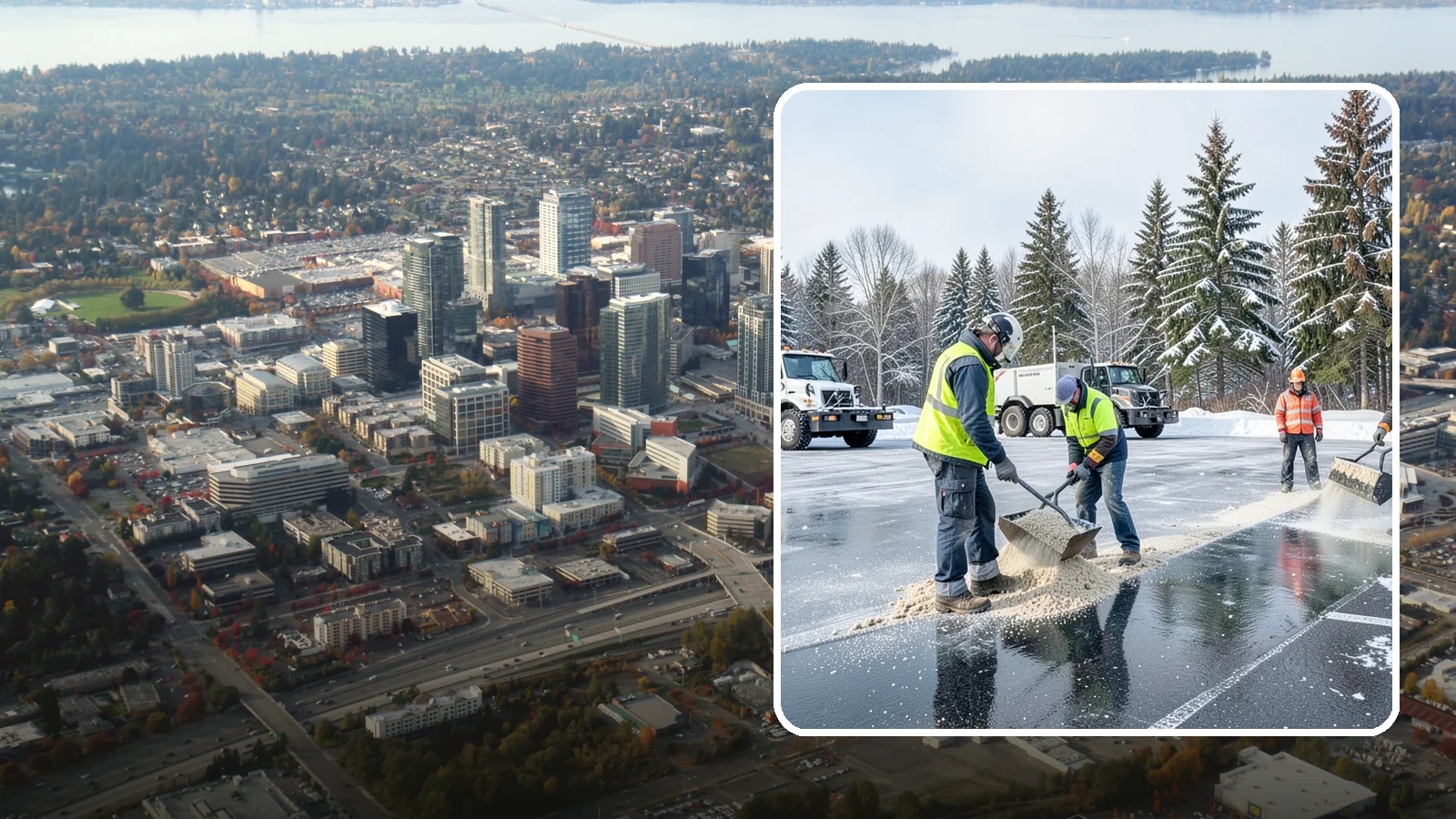
When temperatures fall too low for salt to work, we spread sand to restore traction across your lot.
Parking Lot Sanding in Bellevue is mostly about ice, not deep snow. The city averages 7.2 in of snow per season, and only 2.1 days a year bring 1 in or more. But there are 30 freezing nights between Oct and Apr, and that is when lots get slick.
Washington Snow Removal is licensed, bonded and insured. We work out of Bothell, 31 minutes from Bellevue. Call 206-809-9669 to talk about your lot. Bellevue has 873 mapped surface parking lots, and each one drains and ices a little differently.
How often Bellevue pavement freezes
Average snowfall by month in Bellevue
Ice storms and freezing rain near Bellevue
- Dec 23, 2022: Ice Storm; Freezing Rain reported at Sammamish
- Jan 17, 2024: Freezing Rain reported at 1 SSW Sahalee
Sources: NOAA and National Weather Service records for Bellevue, 2005–2026.
How Parking Lot Sanding Works in Bellevue, WA
Sanding a parking lot means putting traction material on pavement that is icy or about to be. In Bellevue, that usually follows a freezing night, a light snowfall, or freezing rain. Light-snow days that need deicing average 3.24 a year, and snow is on the ground about 4 days a year.
Ice events are rare but real. Records show an ice storm on Dec 23, 2022, and freezing rain the same day at Sammamish. Freezing rain was also reported near Sahalee on Jan 17, 2024. Only 1.2 days a year stay below freezing, so most ice forms overnight and melts by afternoon. That makes timing matter more than volume.
On a typical lot visit, the work can include:
- Bulk salt applied at $300 / ton
- Bagged ice melt at $45 / 50 lb bag for entries and small areas
- Spreader truck with driver (Ram 5500) at $325 / hour
- Crew members for walkways and hand work at $110 / person-hour
Bellevue is trip zone A, with a $200 / dispatch trip charge. Each dispatch has a 2-hour minimum. Call 206-809-9669 for details.
Prices in Bellevue
Billed by the hour for the crew and equipment on site, plus materials.
| Plow and spreader truck with driver (Ram 5500) | $325 / hour |
| Ice melt, bagged | $45 / 50 lb bag |
| Bulk salt, applied | $300 / ton |
| Crew member (shoveling, sidewalks, hand work) | $110 / person-hour |
| Trip charge for Bellevue (zone A) | $200 / dispatch |
- 2-hour minimum per dispatch.
- Bellevue is 31 minutes from our Bothell yard.
Prices approved Oct 2026.
Mapped surface parking lots in Bellevue
There are 873 mapped surface parking lots mapped within Bellevue.
Source: OpenStreetMap contributors, Oct 2026. Named sites are examples of local facilities, not customers.
Service Area
Bellevue
Benefits
Immediate traction on packed snow and ice; effective when deicers stall in extreme cold; safe for temperature-sensitive surfaces; pairs with salt for layered coverage; well suited to cold northeasterly wind events