Keeping You Moving. Beyond Expectations.

Kent Commercial Stair Clearing
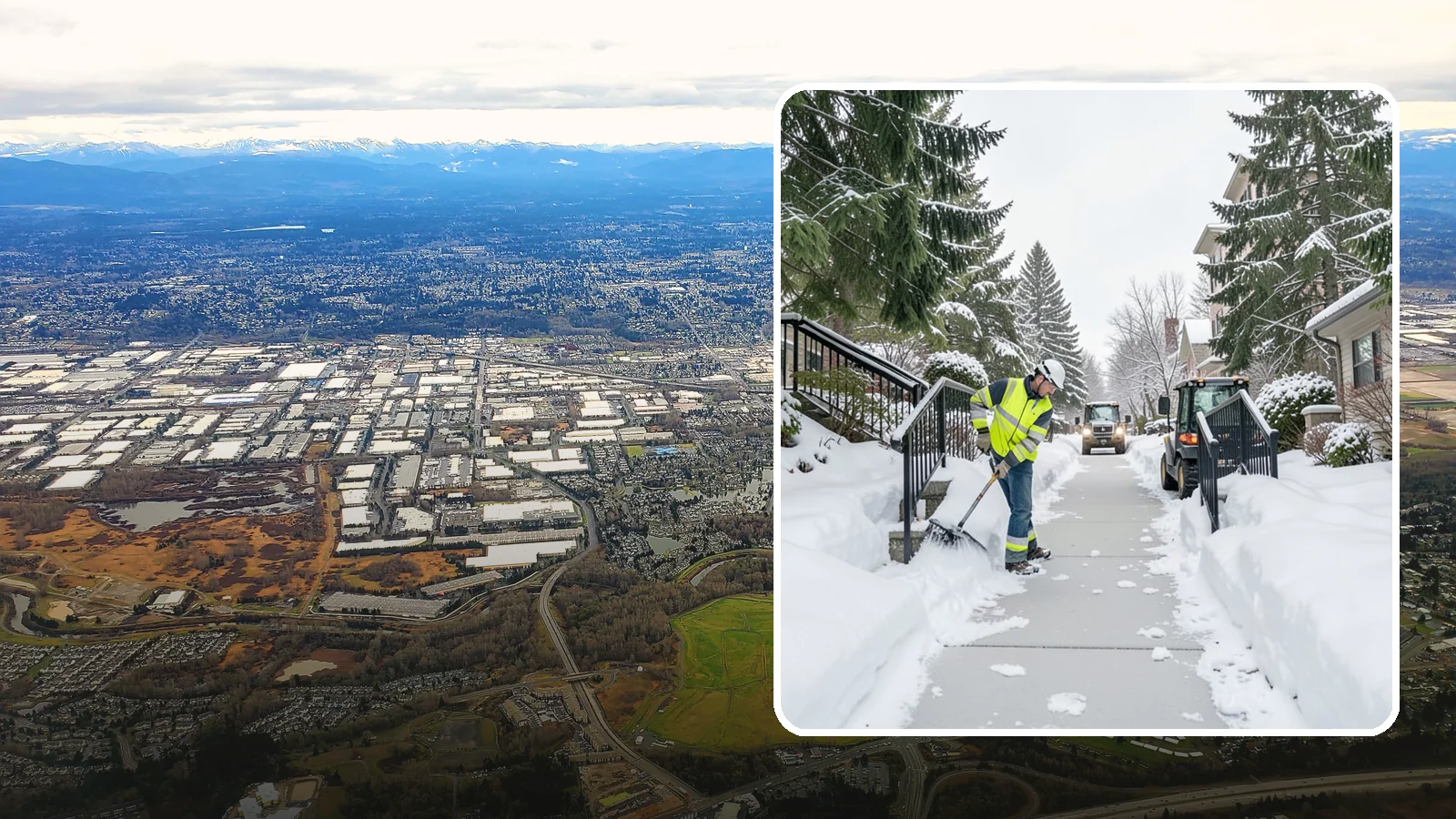
Keep exterior stairs and landings on your commercial property safe and slip-free through Western Washington ice events.
Washington Snow Removal clears snow and ice from commercial stairs in Kent, WA. That covers entry steps, exterior stairways, landings and handrail areas at offices, retail centers, warehouses and apartment-style buildings. We are licensed, bonded and insured, and we work from our Bothell yard, 50 minutes from Kent.
Kent does not get much snow. It averages 5.0 in per season, and 62% of winters see at least one 1-inch day. Stairs still turn dangerous fast on a freezing night. Call 206-809-9669 to arrange stair clearing for your property.
Snow and ice on Kent sidewalks
Recent winter events logged for the Kent area
- Feb 4, 2025: Winter Weather
- Oct 28, 2023: Cold/Wind Chill
- Dec 19, 2022: Winter Weather
- Dec 26–28, 2021: Cold/Wind Chill; Heavy Snow
Sources: NOAA and National Weather Service records for Kent, 2005–2026.
Commercial Stair Clearing at Kent, WA Properties
Stairs are hand work. A loader cannot clean a step, so a crew member shovels each tread, clears the landings and breaks up packed snow. Then we spread ice melt on the surface.
Kent's pattern shapes how we handle this. Snow is rare, with about 1.3 days a year at 1 inch or more, and snow stays on the ground about 3 days a year. Freezing nights are more common, at 30 between October and April. That means a thin glaze on shaded steps can matter more than a deep snowfall. Recent logged events in the Kent area include Winter Weather on Feb 4, 2025, Cold/Wind Chill on Oct 28, 2023, Winter Weather on Dec 19, 2022, and Cold/Wind Chill on Dec 27, 2021.
Kent's code, KCC 8.01.030(8), KCC 6.04.100(6) and KCC 6.04.110(B), requires snow and ice to be removed from public sidewalks within a reasonable time after it stops being deposited. Stairs that lead to those walks should be kept clear too.
What a visit involves and what it costs:
- Crew member for shoveling and hand work: $110 per person-hour
- Bagged ice melt: $45 per 50 lb bag
- Trip charge for Kent (zone B): $275 per dispatch
- 2-hour minimum per dispatch
Prices in Kent
Billed by the hour for the crew and equipment on site, plus materials.
| Crew member (shoveling, sidewalks, hand work) | $110 / person-hour |
| Compact track loader with operator (Kubota SCL1000) | $175 / hour |
| Ice melt, bagged | $45 / 50 lb bag |
| Trip charge for Kent (zone B) | $275 / dispatch |
- 2-hour minimum per dispatch.
- Kent is 50 minutes from our Bothell yard.
Prices approved Oct 2026.
Service Area
Kent
Benefits
Hand-cleared treads and landings on every run; Traction material applied the full length of stairs; Attention to handrails and top-and-bottom transitions; Prevention of high-severity slip-and-fall injuries