Keeping You Moving. Beyond Expectations.

Mount Vernon Medical Office Sidewalk Clearing
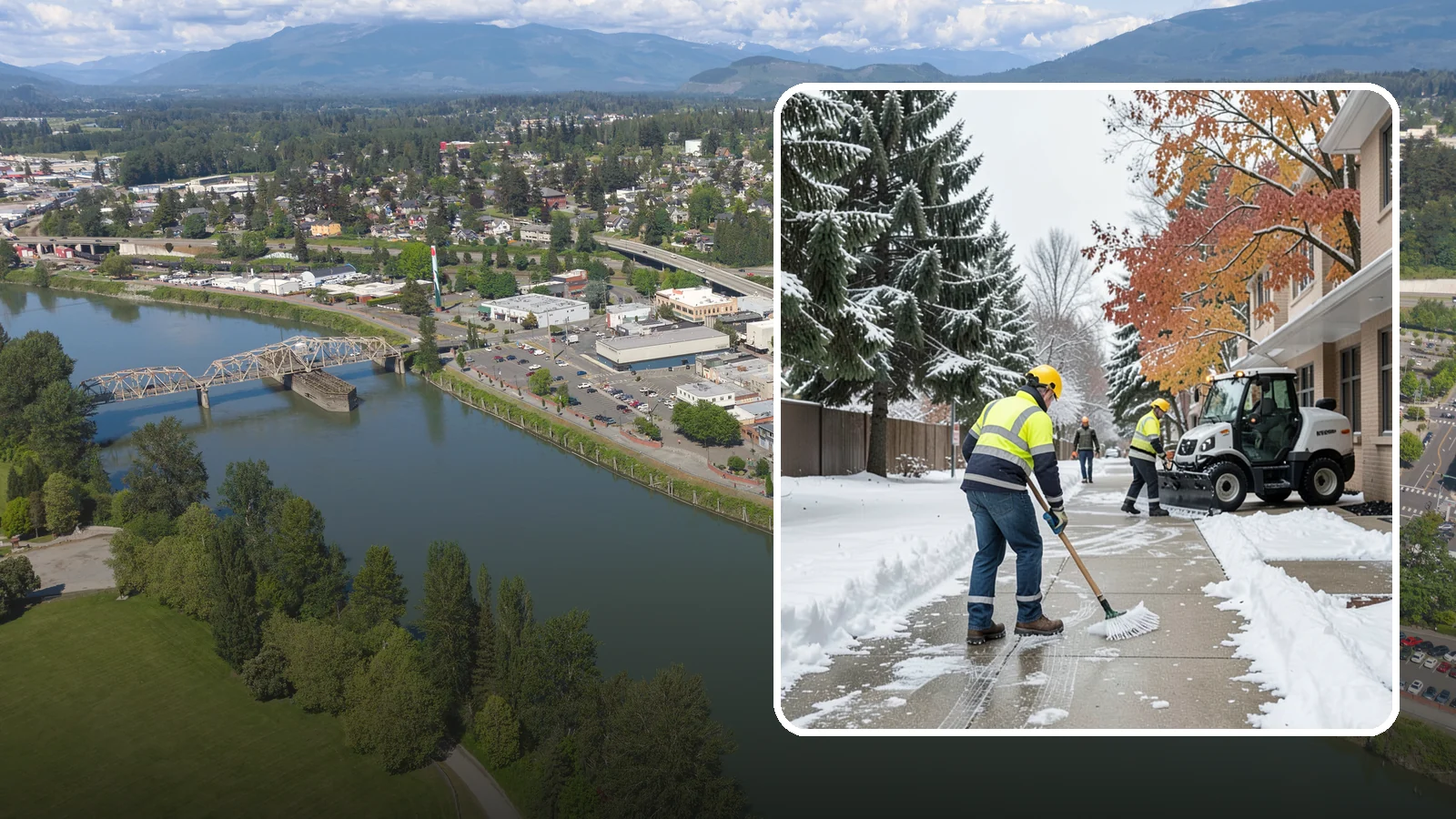
Patient-safety sidewalk clearing for Western Washington medical offices, keeping entrances and accessible routes clear for those with limited mobility.
Medical office sidewalks in Mount Vernon need to be clear and safe for patients, many of whom walk slowly or use mobility aids. Washington Snow Removal is based in Bothell, WA, and is licensed, bonded and insured. We clear walkways, entries and ramps at clinics and medical offices.
Mount Vernon has 41 clinics and medical offices mapped, from dental practices to family clinics. Snow here is infrequent, but a single event can leave icy entries. Call 206-809-9669 to talk through your property.
Mount Vernon walkway conditions in winter
Average snowfall by month in Mount Vernon
Recent winter events logged for the Mount Vernon area
- Feb 3, 2025: Winter Weather
- Nov 29–Dec 1, 2022: Winter Weather; Heavy Snow
- Jan 12–14, 2020: Winter Storm
- Feb 11, 2019: Heavy Snow
Sources: NOAA and National Weather Service records for Mount Vernon, 2005–2026.
Medical Office Sidewalk Clearing in Mount Vernon, WA
At a medical office, the work centers on the path a patient takes: the parking lot edge, the sidewalk, the ramp and the front door. We shovel by hand and apply ice melt where needed.
Mount Vernon averages 8.7 in of snow per season. About 71% of winters see at least one day with 1 inch or more, and the area averages 2.6 such days a year. Snow stays on the ground about 5 days a year. Because storms are short, the larger daily risk is ice. There are 37 freezing nights from Oct to Apr, and about 2.67 light-snow days a year need deicing. Recent logged events include Heavy Snow on Nov 29, 2022, a Winter Storm on Jan 14, 2020 and Jan 12, 2020, and Heavy Snow on Feb 11, 2019.
Mount Vernon is 62 minutes from our Bothell yard, so pricing reflects that distance:
- Crew member for shoveling and sidewalks: $110 per person-hour
- Bagged ice melt: $45 per 50 lb bag
- Trip charge for Mount Vernon (zone C): $350 per dispatch
- Compact track loader with operator (Kubota SCL1000): $175 per hour, for larger lots
Each dispatch has a 2-hour minimum.
Prices in Mount Vernon
Billed by the hour for the crew and equipment on site, plus materials.
| Crew member (shoveling, sidewalks, hand work) | $110 / person-hour |
| Compact track loader with operator (Kubota SCL1000) | $175 / hour |
| Ice melt, bagged | $45 / 50 lb bag |
| Trip charge for Mount Vernon (zone C) | $350 / dispatch |
- 2-hour minimum per dispatch.
- Mount Vernon is 62 minutes from our Bothell yard.
Prices approved Oct 2026.
Clinics and medical offices in Mount Vernon
There are 41 clinics and medical offices mapped within Mount Vernon.
- All Smilez Family & Cosmetic Dentistry
- Carl M. Berliner, MD, PLLC
- Carol Health & Healing
- Cascade Clinic
Source: OpenStreetMap contributors, Oct 2026. Named sites are examples of local facilities, not customers.

Service Area
Mount Vernon
Benefits
Protects vulnerable patients with limited mobility from falls; Accessible routes and drop-off zones treated as top priority; All-day coverage matches continuous appointment traffic; Written service records support clinic risk management; Reduces liability where the duty of care is especially high