Keeping You Moving. Beyond Expectations.

Newcastle Emergency Deicing
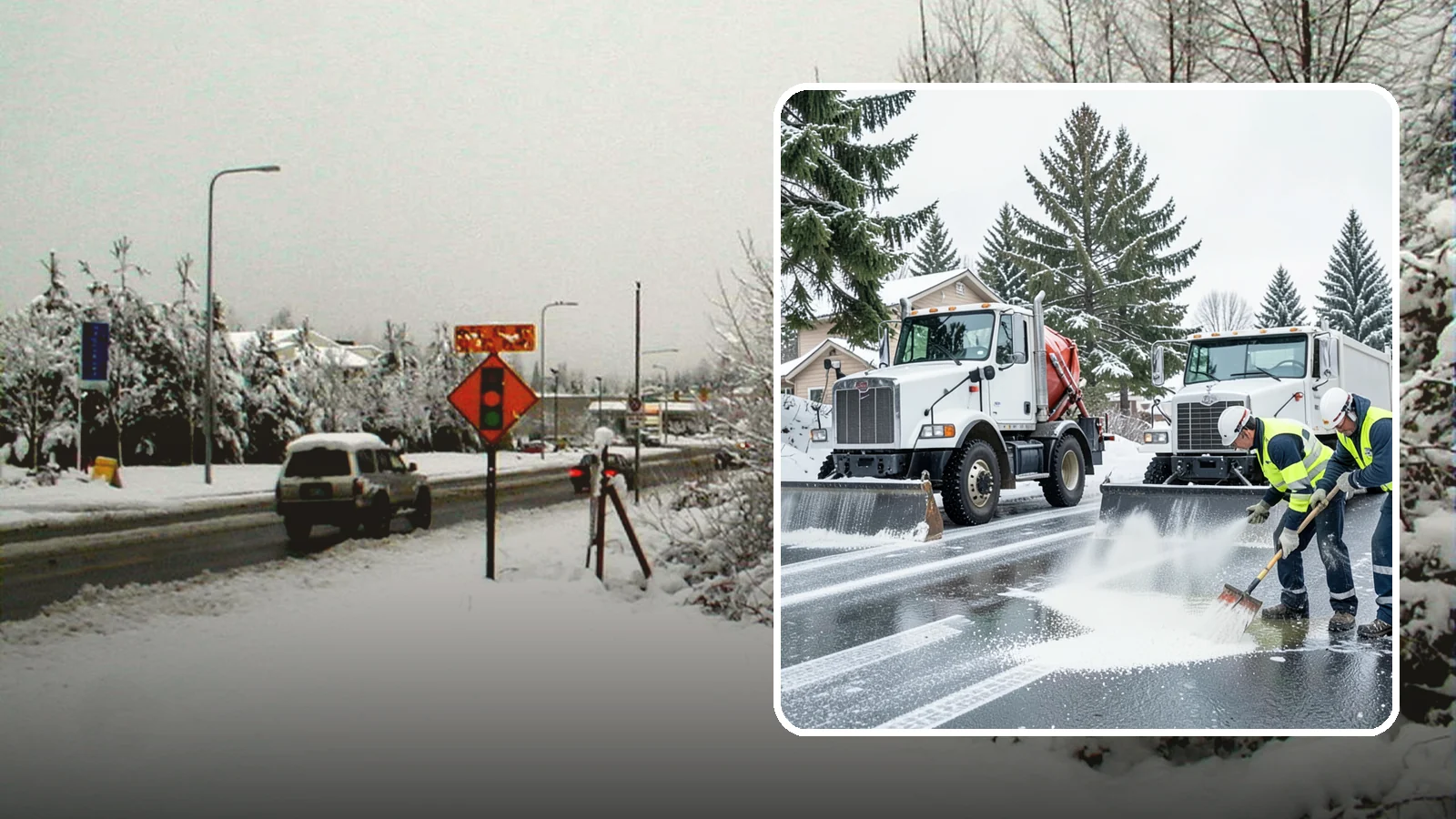
We respond fast across Western Washington to treat icy lots, walks, and entrances when a freeze turns your surfaces into a slip hazard.
Newcastle sits in King County hills where a freezing night can turn a driveway, stairwell or parking lot into glazed ice before anyone is awake. Washington Snow Removal offers emergency deicing for Newcastle properties from our Bothell yard, 35 minutes away. We are licensed, bonded and insured.
Snow here is not constant. Newcastle averages 7.1 in per season and 2.1 days a year with 1 in or more. But the area sees 30 freezing nights from Oct to Apr, and that is when ice forms. Call 206-809-9669 to request a dispatch.
Storm history for Newcastle
Largest snow totals reported near Newcastle
- Feb 13–14, 2021: Up to 12 in, 7 spotter reports: 4.9 SE Seattle 12 in, 1 S Mercer Island 12 in, 1 S Bellevue 11.5 in, Bellevue 11 in, 1 S Bellevue 10.8 in, Bellevue 10.5 in, 5.8 SE Bellevue 9.8 in
- Feb 6, 2017: 8 in measured by a spotter at SSW Renton
- Jan 15–20, 2012: 11.7 in total, 3.2 in on the biggest day
- Dec 21–22, 2008: 7.7 in total, 4.5 in on the biggest day
Sources: NOAA and National Weather Service records for Newcastle, 2005–2026.
What Emergency Deicing Involves in Newcastle, WA
Emergency deicing is a call-out to treat ice that has already formed or is about to. At a Newcastle property, that usually means sloped driveways, entry walks, stairs, loading areas and parking lot lanes where people and vehicles need traction.
The local pattern shapes the work. Snow totals are modest in a typical year, yet the biggest single day since 2005 reached 10.2 in, and spotters near Newcastle reported 12 in, 11 in and 9.8 in on Feb 14, 2021. King County has also logged 27 winter storm and heavy snow reports since 2005, and about 4.29 Winter Weather Advisories a year. With 30 freezing nights from Oct to Apr, refreezing is a bigger issue than deep snow.
Depending on the site, a visit may include:
- Bulk salt applied by truck, $300 / ton
- Bagged ice melt for small areas, $45 / 50 lb bag
- Crew members for stairs, sidewalks and hand work, $110 / person-hour
- Plow and spreader truck with driver (Ram 5500), $325 / hour
Each dispatch has a 2-hour minimum. The Newcastle trip charge (zone A) is $200 per dispatch.
Prices in Newcastle
Billed by the hour for the crew and equipment on site, plus materials.
| Plow truck with driver (Ram 3500) | $250 / hour |
| Plow and spreader truck with driver (Ram 5500) | $325 / hour |
| Compact track loader with operator (Kubota SCL1000) | $175 / hour |
| Crew member (shoveling, sidewalks, hand work) | $110 / person-hour |
| Ice melt, bagged | $45 / 50 lb bag |
| Bulk salt, applied | $300 / ton |
| Trip charge for Newcastle (zone A) | $200 / dispatch |
- 2-hour minimum per dispatch.
- Newcastle is 35 minutes from our Bothell yard.
Prices approved Oct 2026.
Service Area
Newcastle
Benefits
Rapid response to sudden ice and freeze events; Deicer matched to temperature and surface type; Targets the highest-traffic slip hazards first; Reduces injury risk and liability from icy surfaces