Keeping You Moving. Beyond Expectations.

Seattle Anti-Icing
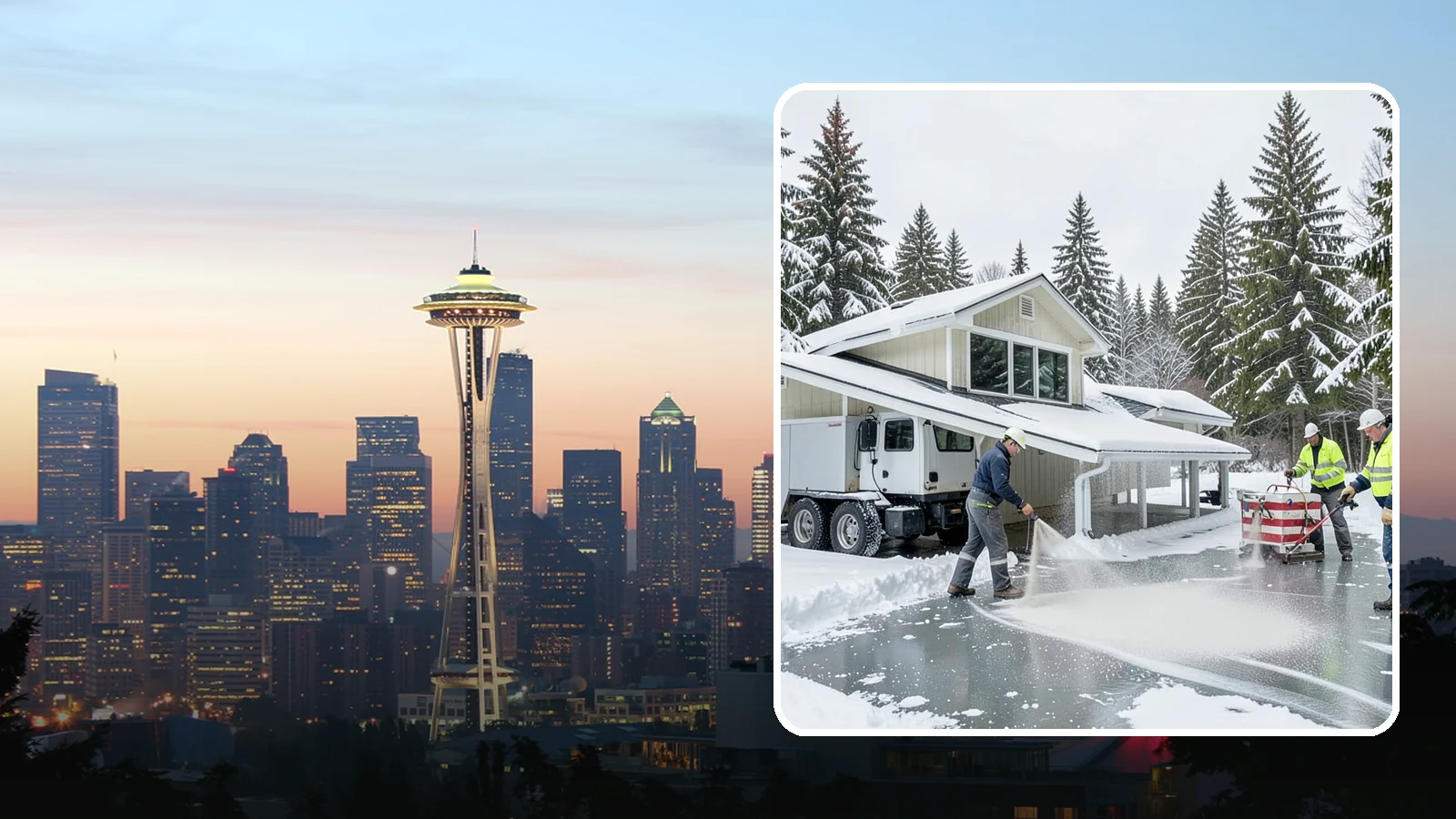
Anti-icing applies deicer proactively before a storm so ice bonds are prevented rather than broken after the fact.
Anti-icing is the application of salt to pavement before ice forms. In Seattle, the risk is less about deep snow and more about freezing nights. The area sees 27 freezing nights between October and April, and ice storms were logged on Dec 23, 2022 and Jan 17, 2024.
Washington Snow Removal is licensed, bonded and insured. We work out of Bothell, 37 minutes from Seattle. Call 206-809-9669 to talk through your lot, walkway or entrance before the next cold snap.
How often Seattle pavement freezes
Average snowfall by month in Seattle
Ice storms and freezing rain near Seattle
- Jan 17, 2024: Ice Storm
- Dec 23, 2022: Ice Storm; Freezing Rain reported at 3 NW Seattle; Freezing Rain reported at West Seattle
Sources: NOAA and National Weather Service records for Seattle, 2005–2026.
How Anti-Icing Works for Seattle Properties
Seattle averages 5.3 in of snow per season. Snow sits on the ground about 3 days a year, and only 1 day a year stays below freezing. Most winter trouble comes from thin ice on cold nights, not from big storms. That is why timing matters. Salt needs to be down before the freeze, not after.
At a typical Seattle property, anti-icing means treating the surfaces people and vehicles use most:
- Parking lots and drive lanes
- Entrances and loading areas
- Ramps and sloped driveways
- Sidewalks next to the property
Seattle code (SMC 15.48.010) makes the owner or occupant of private property responsible for removing snow and ice on the sidewalks abutting it in a timely manner. A pre-treated sidewalk is easier to keep clear.
Ice storms and freezing rain have been reported in Seattle, including West Seattle on Dec 23, 2022. Those events can form ice with little warning.
Pricing is posted. Bulk salt, applied, is $300 per ton. Bagged ice melt is $45 per 50 lb bag. A Seattle trip charge of $275 per dispatch applies (zone B), with a 2-hour minimum per dispatch. A plow and spreader truck with driver (Ram 5500) is $325 per hour.
Prices in Seattle
Billed by the hour for the crew and equipment on site, plus materials.
| Plow and spreader truck with driver (Ram 5500) | $325 / hour |
| Bulk salt, applied | $300 / ton |
| Ice melt, bagged | $45 / 50 lb bag |
| Trip charge for Seattle (zone B) | $275 / dispatch |
- 2-hour minimum per dispatch.
- Seattle is 37 minutes from our Bothell yard.
Prices approved Oct 2026.
Service Area
Seattle
Benefits
Prevents ice bonds before freezing rain arrives; Cuts the labor and material needed to clear surfaces; Targets freezing rain and drizzle unique to the PNW; Keeps access routes open from the storm’s first hour