Keeping You Moving. Beyond Expectations.

Seattle Commercial Stair Clearing
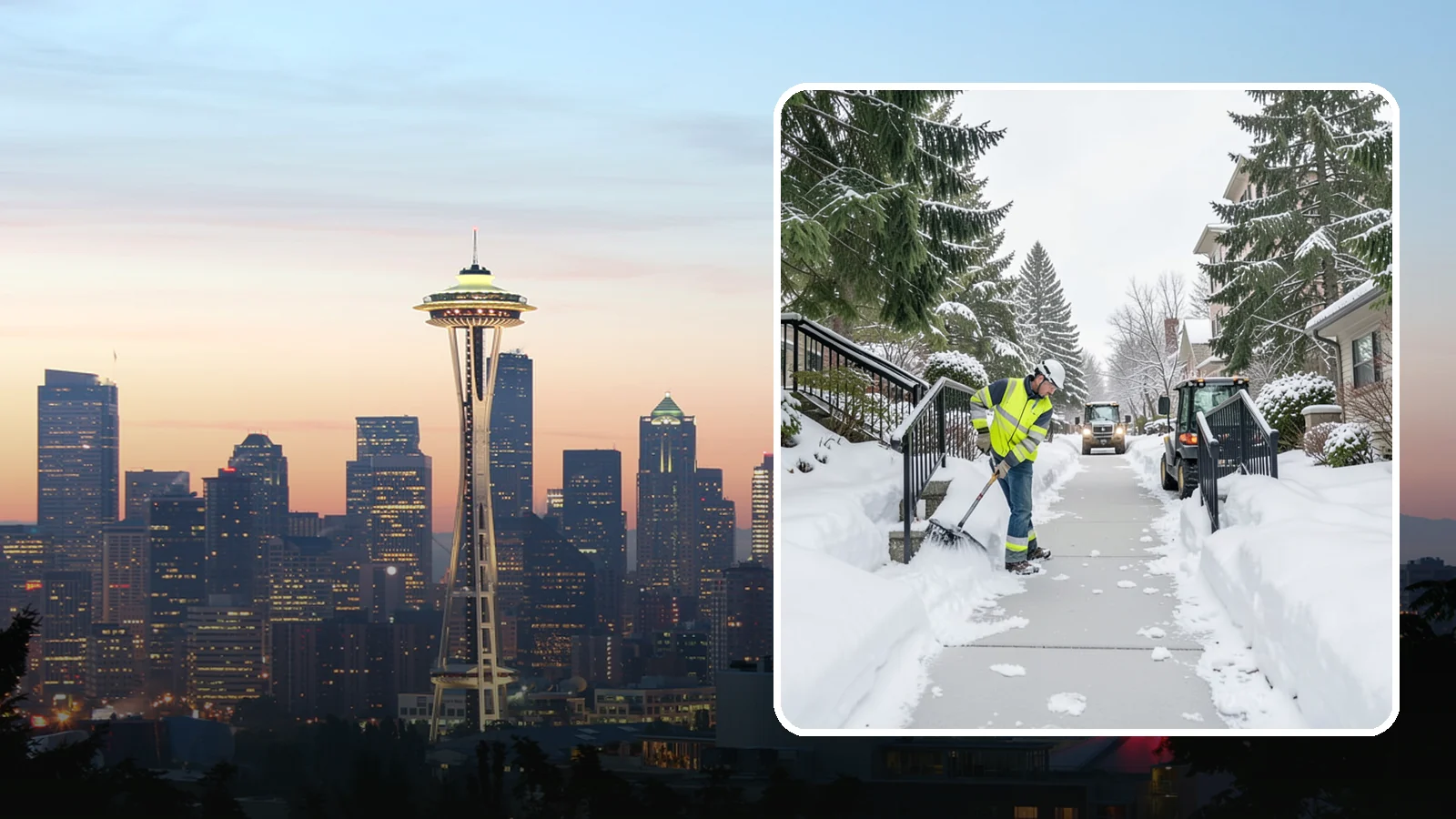
Keep exterior stairs and landings on your commercial property safe and slip-free through Western Washington ice events.
Commercial stairs in Seattle are small areas with high risk. A thin layer of ice on an entry stair, a loading dock step or an exterior walkway can cause a fall even when the street looks clear. Washington Snow Removal clears and treats these stairs by hand.
We are licensed, bonded and insured, and we dispatch from our Bothell yard, 37 minutes from Seattle. Call 206-809-9669 to talk through your property. Seattle averages 5.3 in of snow per season, so the work is occasional but it matters when it comes.
Snow and ice on Seattle sidewalks
Recent winter events logged for the Seattle area
- Feb 4, 2025: Winter Weather
- Jan 12, 2024: Cold/Wind Chill
- Dec 23, 2022: Ice Storm
- Dec 26–28, 2021: Cold/Wind Chill; Heavy Snow
Sources: NOAA and National Weather Service records for Seattle, 2005–2026.
Commercial Stair Clearing in Seattle: What the Work Involves
Stair clearing is hand work. Machines cannot reach treads, landings and handrail zones, so crews use shovels, brooms and ice melt. We clear each step edge to edge, then treat the surface so meltwater does not refreeze overnight.
Seattle's pattern shapes how we plan. Only 1.0 day a year stays below freezing, but there are 27 freezing nights from Oct to Apr. The city sees about 1.6 days a year with 1 in or more of snow, and 62% of winters have at least one such day. Light-snow days that need deicing average 1.95 a year. That means thin ice and refreeze are often a bigger problem than deep snow. Recent logged events include an ice storm on Dec 23, 2022 and winter weather on Feb 4, 2025.
Seattle code (SMC 15.48.010) makes the owner or occupant responsible for removing snow and ice on sidewalks abutting the property in a timely manner. Stairs that connect to those walks should be handled the same way.
- Crew member: $110 per person-hour
- Ice melt, bagged: $45 per 50 lb bag
- Trip charge for Seattle (zone B): $275 per dispatch
- 2-hour minimum per dispatch
Prices in Seattle
Billed by the hour for the crew and equipment on site, plus materials.
| Crew member (shoveling, sidewalks, hand work) | $110 / person-hour |
| Compact track loader with operator (Kubota SCL1000) | $175 / hour |
| Ice melt, bagged | $45 / 50 lb bag |
| Trip charge for Seattle (zone B) | $275 / dispatch |
- 2-hour minimum per dispatch.
- Seattle is 37 minutes from our Bothell yard.
Prices approved Oct 2026.
Service Area
Seattle
Benefits
Hand-cleared treads and landings on every run; Traction material applied the full length of stairs; Attention to handrails and top-and-bottom transitions; Prevention of high-severity slip-and-fall injuries