Keeping You Moving. Beyond Expectations.

Seattle Gas Station Deicing
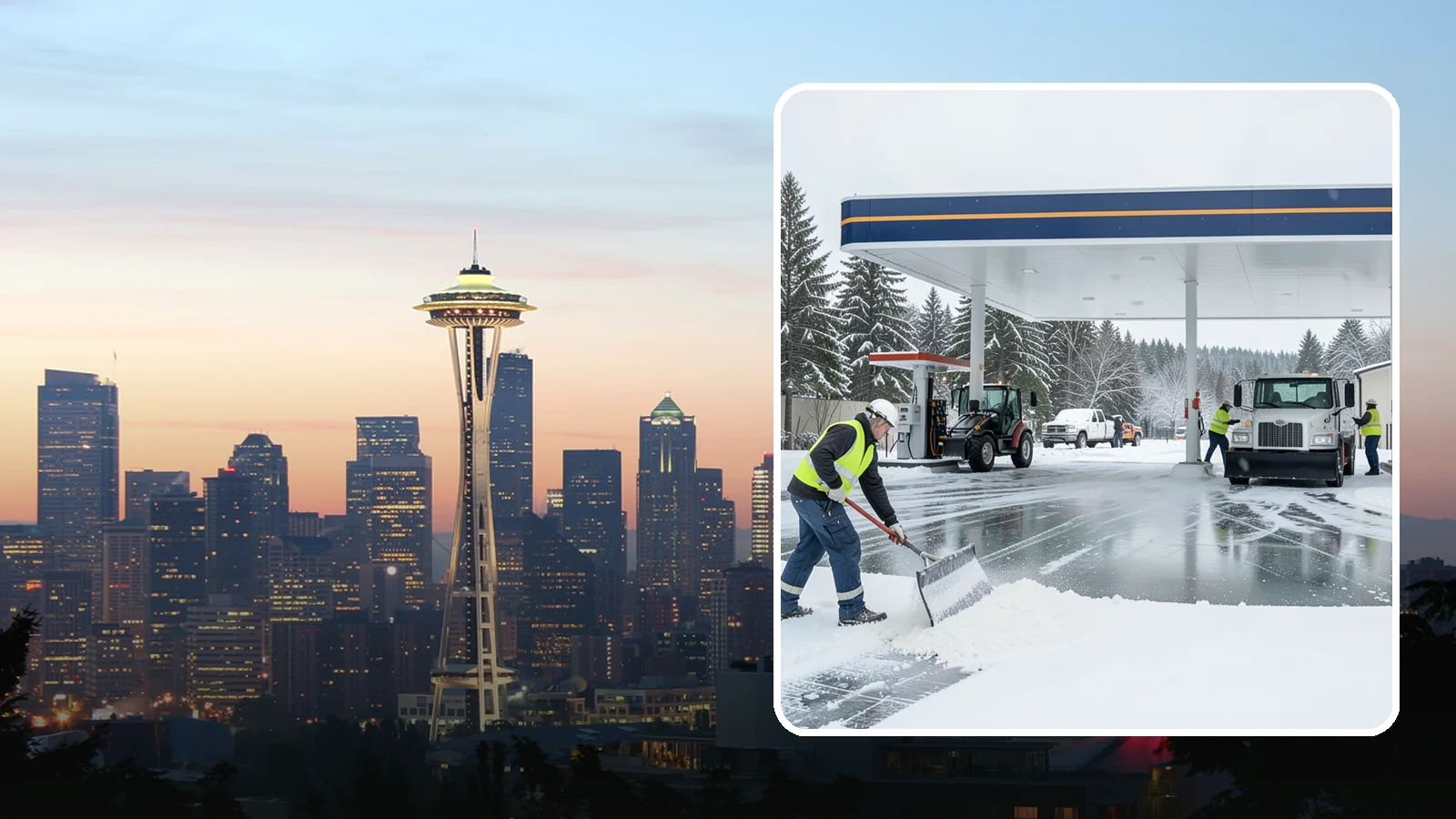
Deicing for gas stations and convenience stores, keeping fuel islands, pump approaches, and store entrances safe during a hard freeze.
Washington Snow Removal provides gas station deicing in Seattle from our Bothell yard, 37 minutes away. We are licensed, bonded and insured. Seattle has 128 gas stations mapped within the city, and each one has pumps, drive lanes and walkways where ice causes problems.
Seattle sees few snow days, but it logs 27 freezing nights between October and April. A thin glaze on a fuel island or apron is enough to cause a fall. Call 206-809-9669 to set up a dispatch.
How often Seattle pavement freezes
Average snowfall by month in Seattle
Recent winter events logged for the Seattle area
- Jan 12, 2024: Cold/Wind Chill
- Dec 23, 2022: Ice Storm
- Dec 26–28, 2021: Cold/Wind Chill; Heavy Snow
- Feb 12, 2021: Winter Storm
Sources: NOAA and National Weather Service records for Seattle, 2005–2026.
Gas Station Deicing in Seattle: What the Work Involves
A gas station has a lot of walking surface. Customers step out at the pumps, cross the apron to the store door and walk the sidewalk along the street. We treat those areas with salt or ice melt and clear slush from drains and drive lanes where needed.
Seattle gets an average of 5.3 in of snow per season and only 1.6 days a year with 1 in or more. Days that stay below freezing average 1.0. The bigger issue is the 27 freezing nights, when wet pavement turns to ice before anyone is on site. The area has also had 3 ice storm reports logged since 2005. Recent events include an Ice Storm on Dec 23, 2022 and a Winter Storm on Feb 12, 2021. Seattle averages 3.29 Winter Weather Advisories a year.
Seattle code SMC 15.48.010 makes the owner or occupant responsible for removing snow and ice from sidewalks abutting the property in a timely manner. That includes the sidewalk at the station's frontage.
Pricing for Seattle:
- Plow and spreader truck with driver (Ram 5500): $325 / hour
- Bulk salt, applied: $300 / ton
- Ice melt, bagged: $45 / 50 lb bag
- Crew member for sidewalks and hand work: $110 / person-hour
- Trip charge (zone B): $275 / dispatch
Each dispatch has a 2-hour minimum.
Prices in Seattle
Billed by the hour for the crew and equipment on site, plus materials.
| Plow and spreader truck with driver (Ram 5500) | $325 / hour |
| Ice melt, bagged | $45 / 50 lb bag |
| Bulk salt, applied | $300 / ton |
| Crew member (shoveling, sidewalks, hand work) | $110 / person-hour |
| Trip charge for Seattle (zone B) | $275 / dispatch |
- 2-hour minimum per dispatch.
- Seattle is 37 minutes from our Bothell yard.
Prices approved Oct 2026.
Gas stations in Seattle
There are 128 gas stations mapped within Seattle.
Source: OpenStreetMap contributors, Oct 2026. Named sites are examples of local facilities, not customers.
Service Area
Seattle
Benefits
Keeps fuel islands and store entrances safe for customers; Treats pump approaches where vehicles and people mix; Handles nonstop turnover with frequent service; Reduces slip liability at a high-traffic fueling site; Uses deicer safe for sealed concrete around pumps