Keeping You Moving. Beyond Expectations.

Tacoma Beet Juice Deicer Application
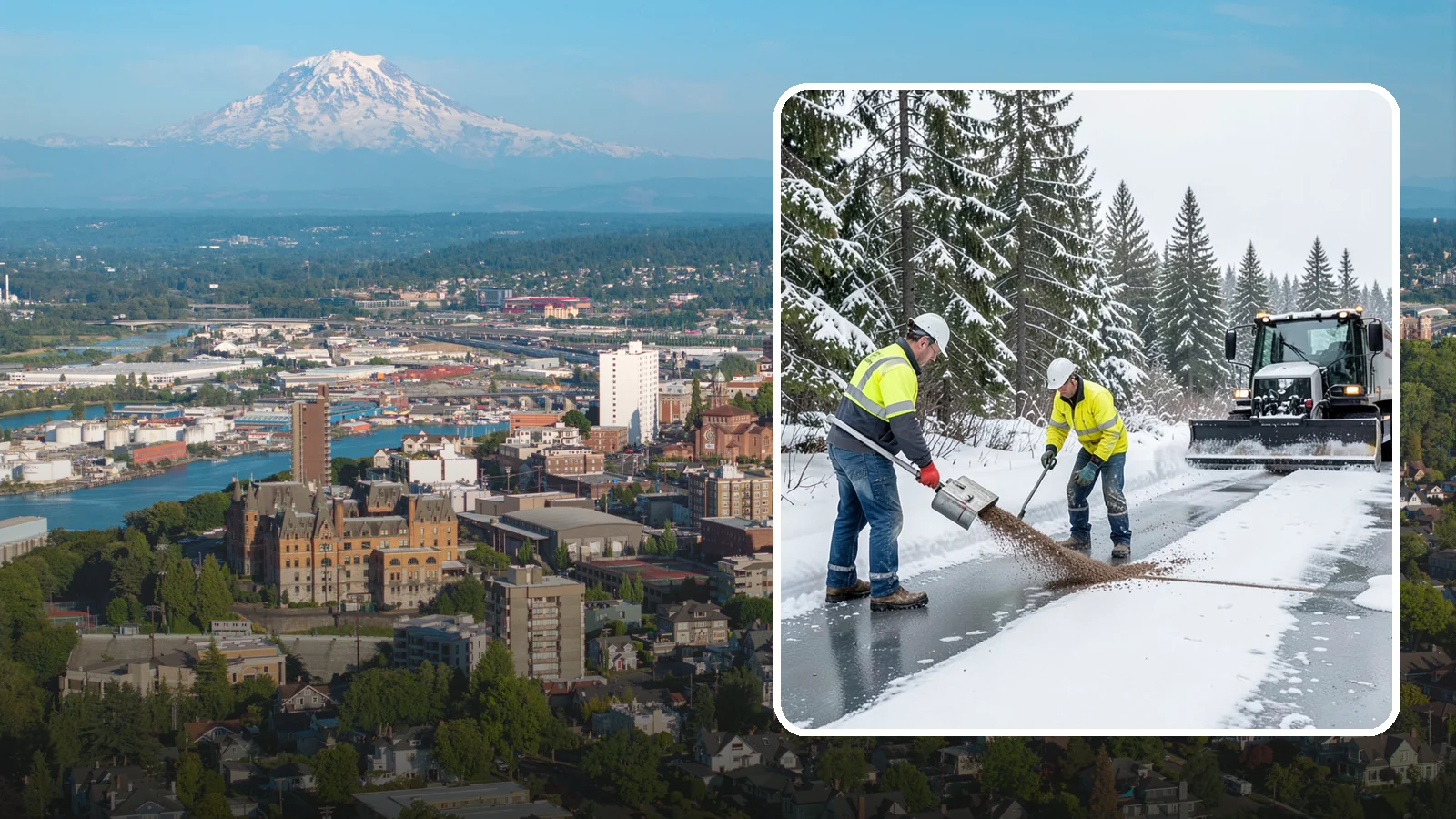
Beet juice deicer application blends an agricultural byproduct with brine to melt ice at colder temperatures using less salt.
Tacoma does not get much snow, but it gets plenty of cold nights. There are 31 freezing nights between October and April, and that is when thin ice forms on walks, ramps and parking lots. Washington Snow Removal applies beet juice deicer to keep that ice from bonding to pavement.
We are licensed, bonded and insured, and we dispatch from our Bothell yard, 73 minutes from Tacoma. Call 206-809-9669 to talk through your property and the timing of an application.
Ice and freezing nights in Tacoma
Recent winter events logged for the Tacoma area
- Dec 23, 2022: Ice Storm
- Dec 1, 2022: Winter Weather
- Feb 12, 2021: Winter Storm
- Feb 22, 2018: Heavy Snow
Sources: NOAA and National Weather Service records for Tacoma, 2005–2026.
How beet juice deicer works at Tacoma properties
Beet juice deicer is a liquid sprayed on pavement before or during a freeze. It lowers the temperature at which water turns to ice and helps stop frost and light ice from bonding to the surface. That makes the later shoveling or scraping easier.
Tacoma's pattern suits this kind of work. The average snowfall is 5.6 in per season, and only 1.6 days a year bring 1 in or more. Just 1.3 days a year stay below freezing all day. Most of the problem comes from freezing nights, 31 of them from October to April, and from occasional events. Recent ones logged for the Tacoma area include an ice storm on Dec 23, 2022, winter weather on Dec 1, 2022, a winter storm on Feb 12, 2021, and heavy snow on Feb 22, 2018.
Tacoma's sidewalk rule, TMC 9.16.050, puts the duty on the person in charge of the premises to clear public walks of snow or ice. The deadline is 24 hours. Treating walks ahead of a freeze can make that job easier.
Pricing for a dispatch to Tacoma:
- Trip charge for Tacoma (zone C): $350 per dispatch
- Spreader truck with driver: $325 per hour
- Crew member for sidewalks and hand work: $110 per person-hour
- 2-hour minimum per dispatch
Prices in Tacoma
Billed by the hour for the crew and equipment on site, plus materials.
| Plow and spreader truck with driver (Ram 5500) | $325 / hour |
| Ice melt, bagged | $45 / 50 lb bag |
| Bulk salt, applied | $300 / ton |
| Crew member (shoveling, sidewalks, hand work) | $110 / person-hour |
| Trip charge for Tacoma (zone C) | $350 / dispatch |
- 2-hour minimum per dispatch.
- Tacoma is 73 minutes from our Bothell yard.
Prices approved Oct 2026.
Service Area
Tacoma
Benefits
Extends brine’s effective range into colder temperatures; Cuts total chloride use by improving salt performance; Sticks to pavement better, resisting wash-off from drizzle; Draws on a renewable agricultural byproduct