Keeping You Moving. Beyond Expectations.

Tacoma Sidewalk Deicing
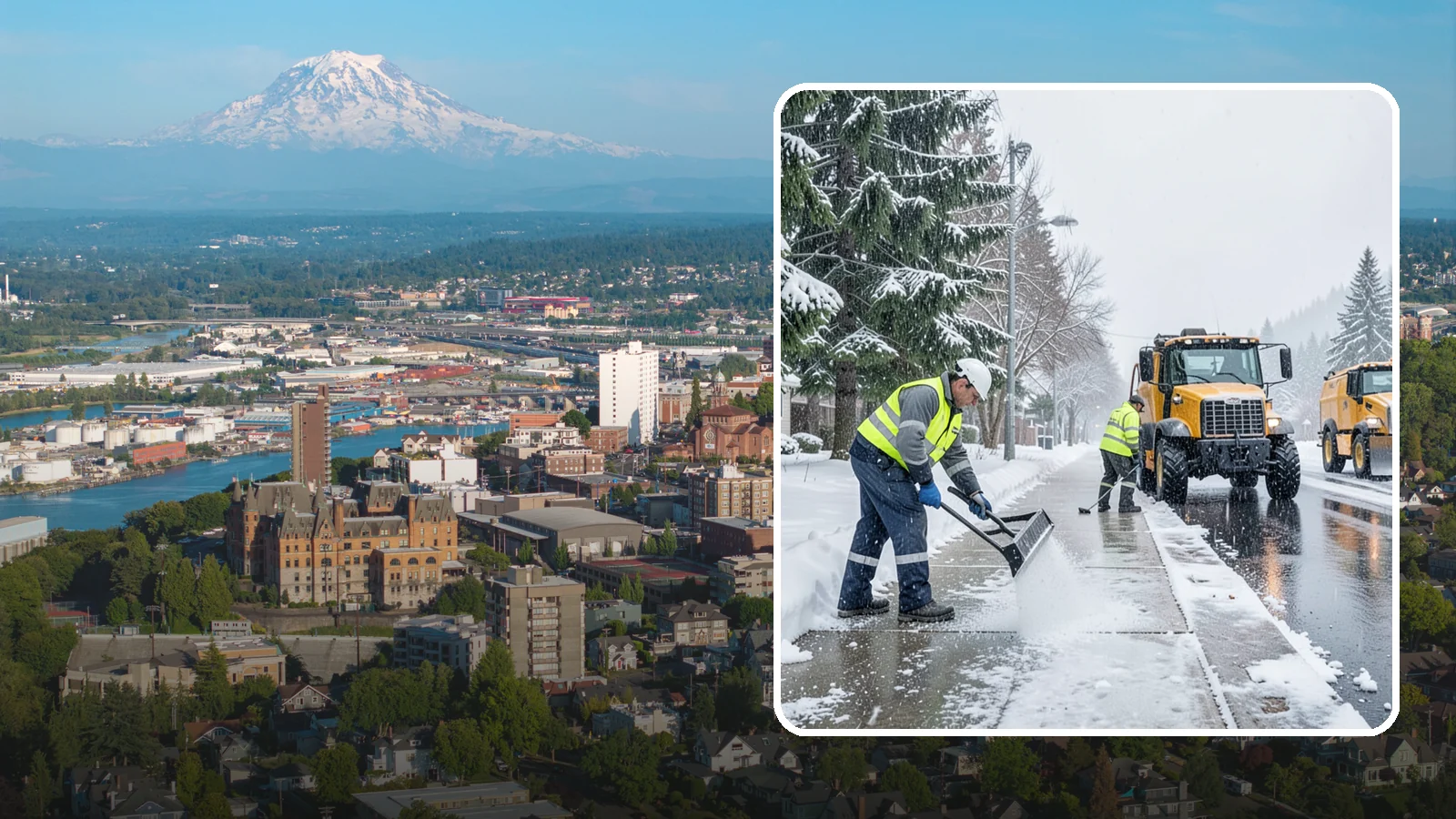
We deice sidewalks to stop the glare ice that forms when Western Washington freezing rain meets cold pavement.
Sidewalk deicing in Tacoma is mostly about thin ice, not deep snow. The city averages 5.6 in of snow a season and has 31 freezing nights from October to April. A wet sidewalk can freeze overnight with no snow at all.
Washington Snow Removal is licensed, bonded and insured. We work from our Bothell yard, 73 minutes from Tacoma. We apply ice melt and salt to public walks, entrances and walkways so they are safer to use. Call 206-809-9669 to set up service.
Ice and freezing nights in Tacoma
Ice storms and freezing rain near Tacoma
- Dec 23, 2022: Ice Storm; Freezing Rain reported at 1 N University Place
- Jan 19, 2012: Ice Storm; Freezing Rain reported at 4 W Federal Way
Sources: NOAA and National Weather Service records for Tacoma, 2005–2026.
Sidewalk Deicing in Tacoma: What the Work Involves
Tacoma gets only about 3 days a year with snow on the ground and 1.6 days with 1 in or more. But 3.05 light-snow days a year need deicing, and the city sees 3.38 Winter Weather Advisories a year. Most of our work here is treatment of thin snow, frost and refrozen melt on walks.
Ice events matter too. Tacoma-area reports include an Ice Storm on Jan 19, 2012 and Freezing Rain on Dec 23, 2022 at 1 N University Place. Those are the days a clear-looking walk turns slick.
Property owners also have a legal duty. Tacoma code TMC 9.16.050 requires the person in charge of a premises to remove snow or ice from the public walks beside or in front of it. The deadline is 24 hours.
A typical visit includes:
- Hand shoveling of any loose snow from walks
- Ice melt or bulk salt applied to sidewalks and entrances
- Treatment of problem spots where meltwater refreezes
Pricing: crew members are $110 per person-hour, bagged ice melt is $45 per 50 lb bag, and bulk salt applied is $300 per ton. The Tacoma trip charge (zone C) is $350 per dispatch, with a 2-hour minimum per dispatch.
Prices in Tacoma
Billed by the hour for the crew and equipment on site, plus materials.
| Plow and spreader truck with driver (Ram 5500) | $325 / hour |
| Ice melt, bagged | $45 / 50 lb bag |
| Bulk salt, applied | $300 / ton |
| Crew member (shoveling, sidewalks, hand work) | $110 / person-hour |
| Trip charge for Tacoma (zone C) | $350 / dispatch |
- 2-hour minimum per dispatch.
- Tacoma is 73 minutes from our Bothell yard.
Prices approved Oct 2026.
Service Area
Tacoma
Benefits
Stops glare ice from freezing rain; protects owners from slip-and-fall liability; material matched to pavement temperature; timed to the forecast for prevention; reapplication through extended freezes