What Boardwalk Snow Clearing Involves in Tukwila
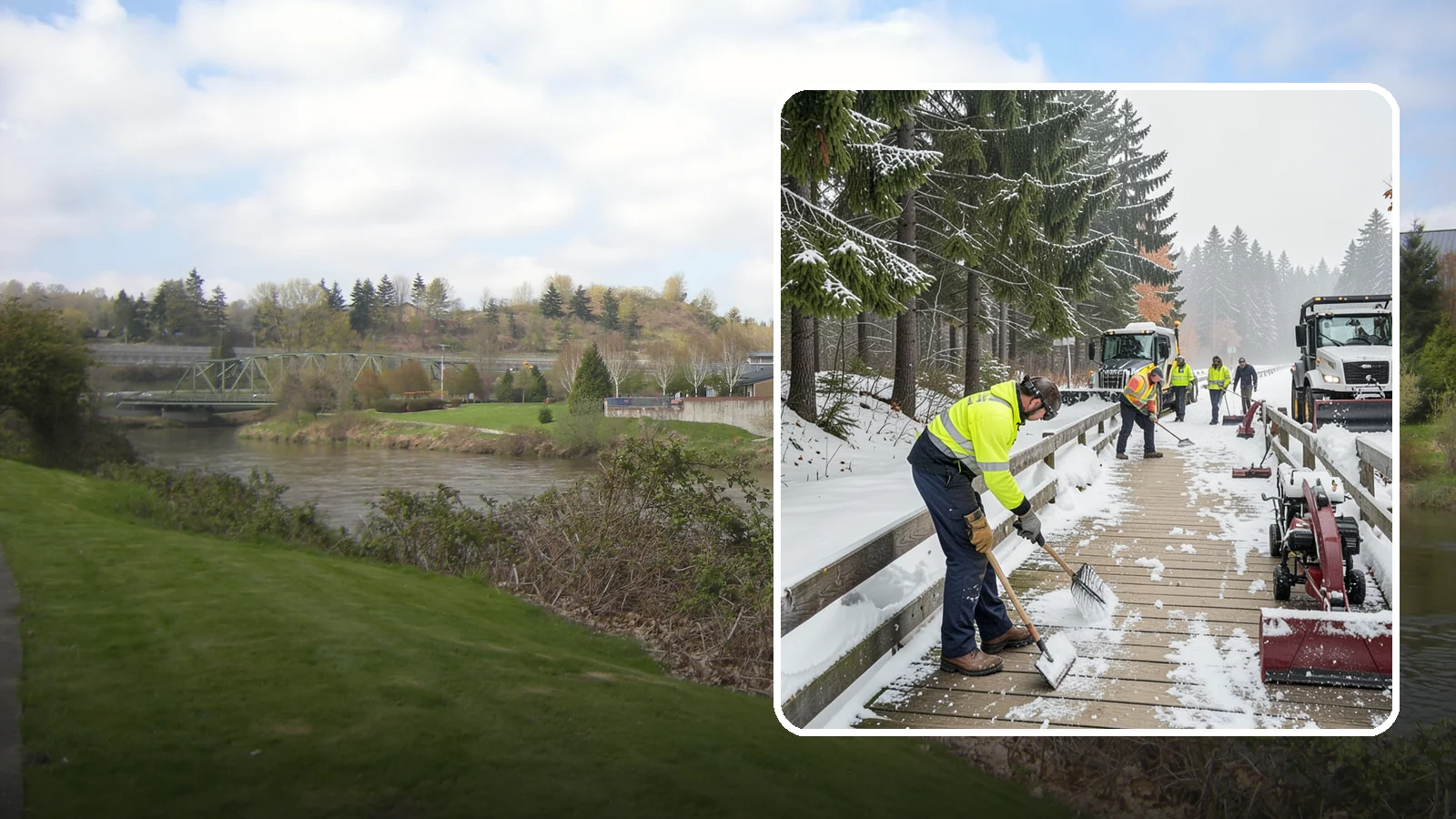
Boardwalks are not like parking lots. Plows and heavy equipment can damage decking, rails and joints, so the work is mostly done by hand. Our crew members shovel and push snow off the surface, clear around steps and landings, and scrape packed spots where foot traffic has pressed snow into ice.
Tukwila gets only 1.8 days a year with 1 in or more of snow. That means most of the risk is not deep snow. It is thin snow and frost on a surface that stays cold. The area averages 2.62 light-snow days a year that need deicing, and 26 freezing nights between October and April. Wet decking can glaze over on any of those nights.
Big storms do happen. Feb 8–12, 2019 brought 14.9 in in total. Feb 12–15, 2021 brought 11.1 in, with 7.4 in on the biggest day. Feb 5–6, 2017 brought 7.6 in. In those events, boardwalks need repeated clearing, not one pass.
- Crew member for shoveling and hand work: $110 per person-hour
- Ice melt, bagged: $45 per 50 lb bag
- Trip charge for Tukwila (zone B): $275 per dispatch
- 2-hour minimum per dispatch
Our yard in Bothell is 46 minutes from Tukwila. A compact track loader with operator is available at $175 per hour for adjoining lots or approach areas.