Keeping You Moving. Beyond Expectations.

Redmond Commercial Snow Removal
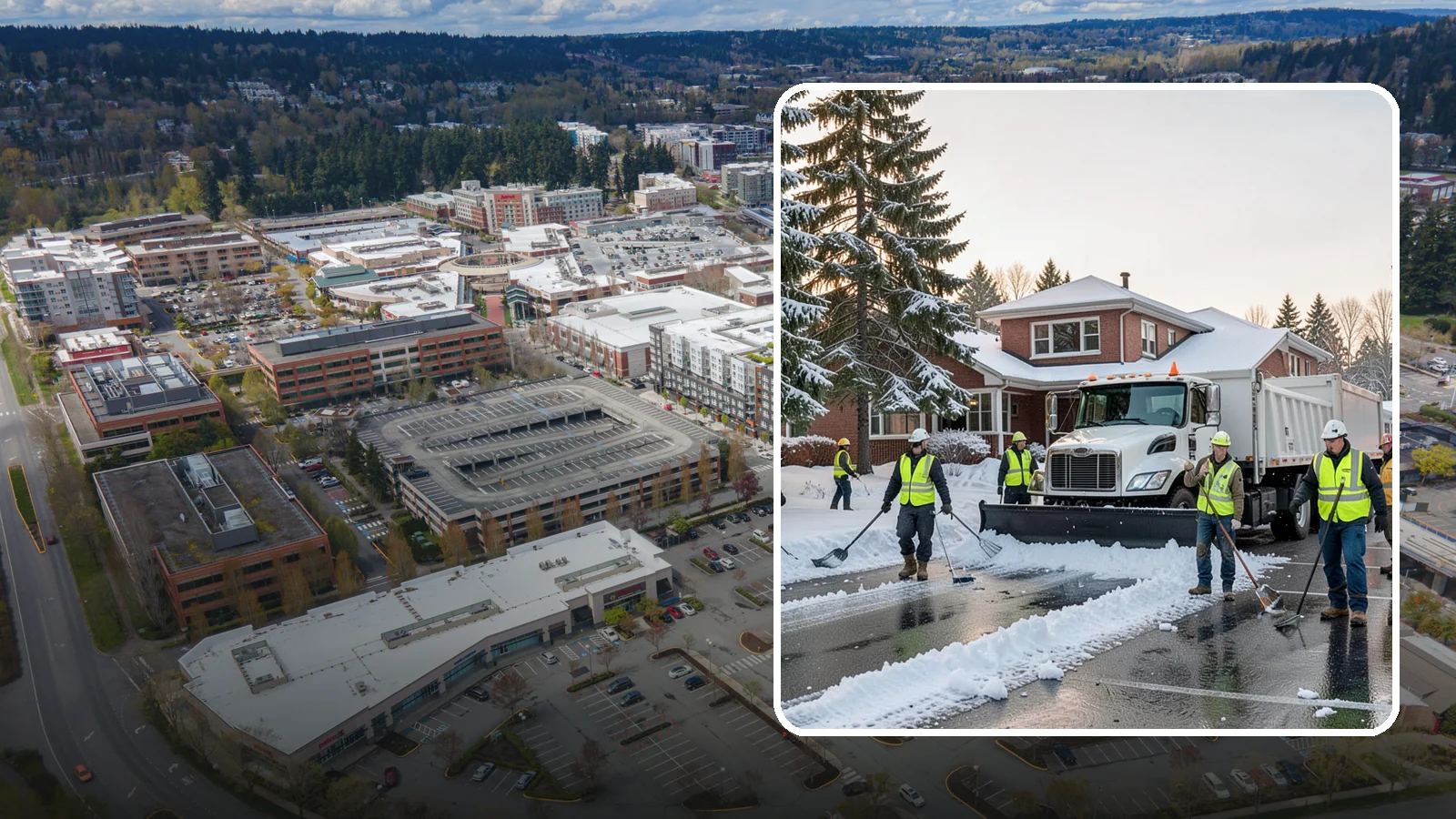
When a Puget Sound cold snap drops wet snow across your commercial property, our crews keep parking areas, walkways, and access points open so business never stops.
Redmond does not get much snow. The average is 7.8 in per season, and only 2.3 days a year bring 1 in or more. But when it does snow, parking lots, entries and sidewalks at commercial sites need to be cleared fast.
Washington Snow Removal is based in Bothell, 27 minutes from Redmond. We are licensed, bonded and insured. We plow, spread and shovel commercial properties here. Call 206-809-9669 to talk through your site.
Redmond winter workload for property managers
Average snowfall by month in Redmond
Largest snow totals reported near Redmond
- Dec 18–19, 2008: Up to 11 in, 2 spotter reports: 3 ENE Redmond 11 in, 3 ENE Redmond 9 in
- Feb 9–12, 2019: Up to 10.5 in, 2 spotter reports: 2 E Woodinville 10.5 in, 2 NNE Sammamish 10 in
- Feb 4, 2019: Up to 9.5 in, 3 spotter reports: Sammamish 9.5 in, 4 N Redmond 9 in, 1.3 ESE Woodinville 9 in
- Feb 14, 2021: 9.4 in measured by a spotter at Kingsgate
Sources: NOAA and National Weather Service records for Redmond, 2005–2026.
Commercial Snow Removal at Redmond Properties
Commercial work in Redmond usually means parking lots, drive aisles, loading areas and walkways. We match the equipment to the site. A Ram 3500 plow truck suits open lots. A Ram 5500 plow and spreader truck can clear and treat in one pass. A Kubota SCL1000 compact track loader handles tighter areas, and crew members shovel sidewalks and entries by hand.
Redmond sees snow in short, sharp events. Since 2005 there have been 27 winter storm and heavy snow reports, and the biggest single day was 7.9 in. Spotters near Redmond reported 10.5 in on Feb 9, 2019 and 9 in on Feb 4, 2019. With 31 freezing nights between Oct and Apr, ice is a bigger part of the season than deep snow. Wet pavement refreezes overnight, so de-icing matters as much as plowing.
- Plow truck with driver (Ram 3500): $250 / hour
- Plow and spreader truck with driver (Ram 5500): $325 / hour
- Compact track loader with operator: $175 / hour
- Crew member: $110 / person-hour
- Bulk salt, applied: $300 / ton
- Bagged ice melt: $45 / 50 lb bag
Each dispatch has a 2-hour minimum and a $200 trip charge for Redmond (zone A).
Prices in Redmond
Billed by the hour for the crew and equipment on site, plus materials.
| Plow truck with driver (Ram 3500) | $250 / hour |
| Plow and spreader truck with driver (Ram 5500) | $325 / hour |
| Compact track loader with operator (Kubota SCL1000) | $175 / hour |
| Crew member (shoveling, sidewalks, hand work) | $110 / person-hour |
| Ice melt, bagged | $45 / 50 lb bag |
| Bulk salt, applied | $300 / ton |
| Trip charge for Redmond (zone A) | $200 / dispatch |
- 2-hour minimum per dispatch.
- Redmond is 27 minutes from our Bothell yard.
Prices approved Oct 2026.
Service Area
Redmond
Benefits
Priority plowing that keeps customers and staff arriving on schedule; Reduced slip-and-fall liability with documented deicing; Local crews who understand wet PNW snow and refreeze cycles; Clear communication before, during, and after each event