Keeping You Moving. Beyond Expectations.

Bellevue Fire Lane Clearing
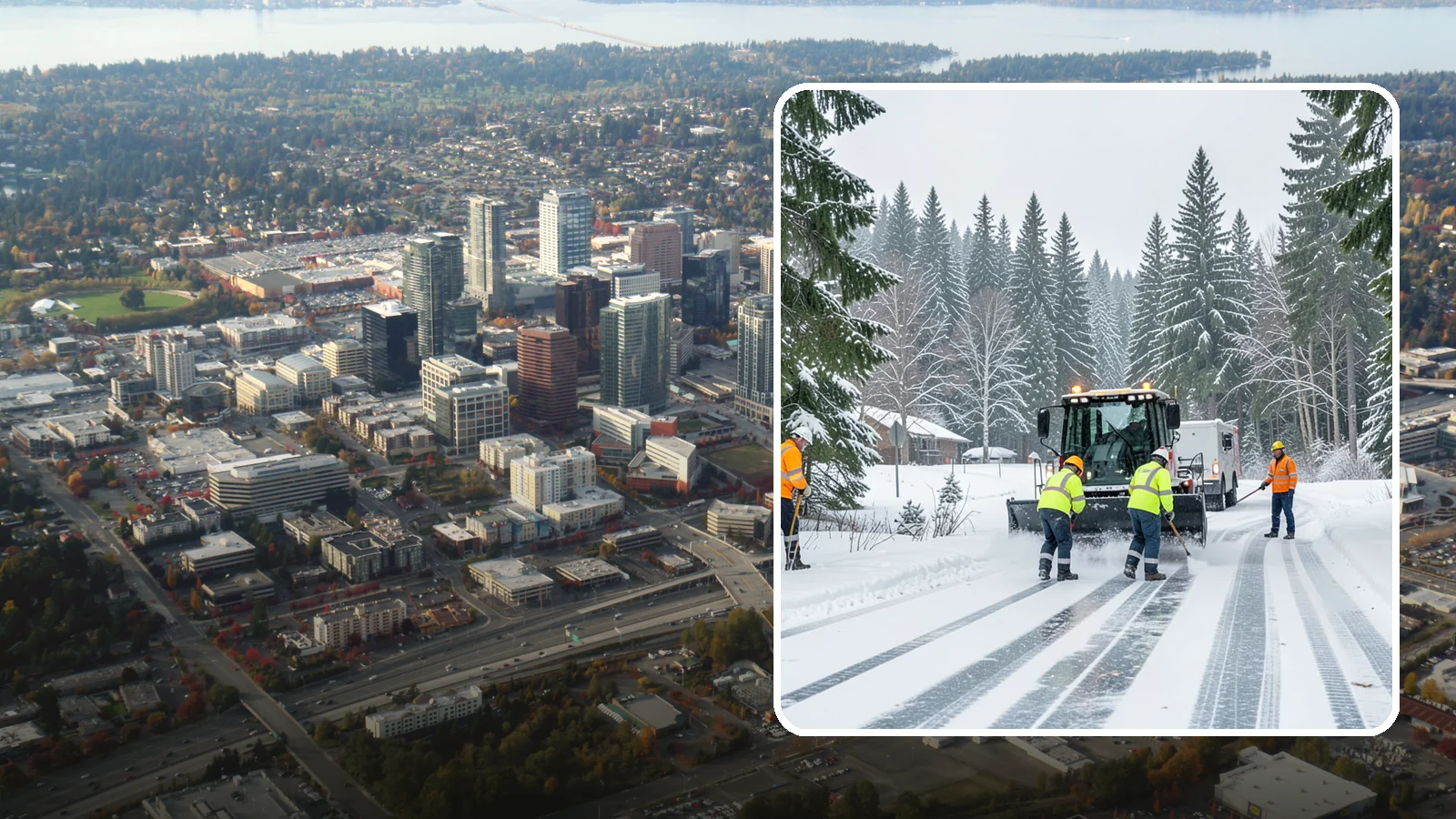
We keep marked fire lanes clear during snow events so emergency vehicles always have unobstructed access.
Fire lanes in Bellevue have to stay open, even when the snow is light. Washington Snow Removal clears fire lanes at commercial and multifamily properties in Bellevue, so engines and emergency crews can reach buildings, hydrants and standpipe connections.
We are licensed, bonded and insured, and we work from our Bothell yard, 31 minutes from Bellevue. Bellevue averages 7.2 in of snow per season, but a single storm can leave far more. Call 206-809-9669 to set up fire lane service before the next event.
Planning a Bellevue snow season
Average snowfall by month in Bellevue
Biggest storms in Bellevue since 2005
- Feb 13–15, 2021: 11.5 in total, 8.1 in on the biggest day
- Dec 18–21, 2008: 9.6 in total, 6.7 in on the biggest day; 8.4 in total, 4.4 in on the biggest day
- Feb 3–5, 2019: 7.5 in total, 6.9 in on the biggest day
- Feb 6–7, 2017: 7.3 in total, 6.7 in on the biggest day
Sources: NOAA and National Weather Service records for Bellevue, 2005–2026.
What Fire Lane Clearing Involves in Bellevue
A fire lane is only useful if it is clear curb to curb. We plow the full width of the lane, clear around hydrants and Fire Department connections, and push snow to spots that do not block access. Crew members shovel the spots a truck cannot reach, such as hydrant bases and corners.
Bellevue sees about 2.1 days a year with 1 in or more of snow and an average of 2.14 plow events per season. That means the work comes in short bursts. Big storms do happen. Dec 18-19, 2008 brought 9.6 in total, and Feb 3-5, 2019 brought 7.5 in total, with 6.9 in on the biggest day.
Ice is the more regular problem. Bellevue has about 30 freezing nights from Oct to Apr and 3.24 light-snow days that need deicing. Thin ice on a fire lane can be as much of a hazard as deep snow, so we apply ice melt or salt where it is needed.
- Plow truck with driver (Ram 3500): $250 / hour
- Crew member for hand work: $110 / person-hour
- Bulk salt, applied: $300 / ton
- Trip charge for Bellevue (zone A): $200 / dispatch
Each dispatch has a 2-hour minimum.
Prices in Bellevue
Billed by the hour for the crew and equipment on site, plus materials.
| Plow truck with driver (Ram 3500) | $250 / hour |
| Plow and spreader truck with driver (Ram 5500) | $325 / hour |
| Compact track loader with operator (Kubota SCL1000) | $175 / hour |
| Crew member (shoveling, sidewalks, hand work) | $110 / person-hour |
| Ice melt, bagged | $45 / 50 lb bag |
| Bulk salt, applied | $300 / ton |
| Trip charge for Bellevue (zone A) | $200 / dispatch |
- 2-hour minimum per dispatch.
- Bellevue is 31 minutes from our Bothell yard.
Prices approved Oct 2026.
Service Area
Bellevue
Benefits
Fire lanes kept clear to full required width; Support for local fire code compliance; Unobstructed access for emergency responders; Careful clearing that avoids blocking adjacent zones; Reduced liability during winter events